
Lenora Pike
When Mercy Goes Viral: Writing The Good Samaritan
August 17, 2026
Featuring: The Good Samaritan
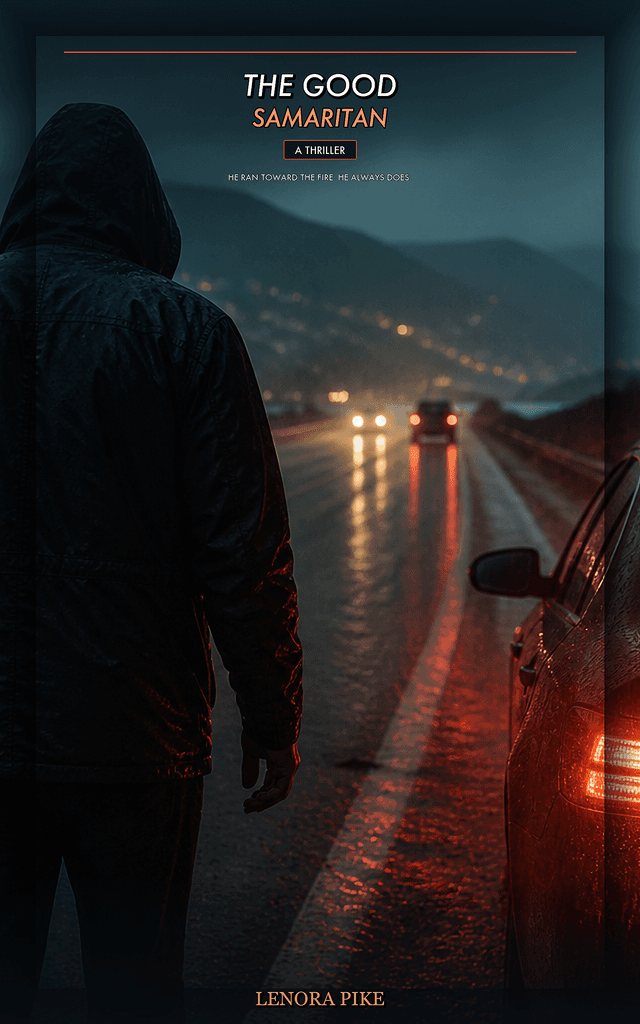
Elliot Reed pulled three strangers from a burning car on I-70 and woke up famous. Doorbell cameras, dashcam fragments, and a nation hungry for heroes turned a warehouse shift into a lifetime label: the Good Samaritan. Then the people he saved started dying. The Good Samaritan is a thriller about what happens when mercy becomes a brand— and someone starts collecting on it.
Hero Stories Are Dangerous
I've always distrusted neat rescue narratives. They flatten everyone involved into roles—rescuer, saved, spectator—and once those roles go viral, the people inside them stop being allowed to be complicated. Elliot doesn't ask for the wristbands or the podcast season. He asks for the names he can't forget to stop shrinking. Fame answers with a different question: prove you're still the man from the video.
That pressure is the engine of the book. Not whether Elliot is good. Whether goodness can survive an audience that needs him to stay simple.
The Podcast as Pressure Cooker
Vera Castillo's true-crime show rebuilds the crash beat by beat, which means every survivor becomes content and every contradiction becomes an episode. I wanted the podcast to feel useful and predatory at the same time—because that's how the genre works when it's hungry. Vera is sharp. She's not a cartoon villain. She's a journalist who knows a season dies without blood, and who keeps telling herself the story still serves the dead.
True-crime culture loves a copycat theory. It loves a stalker in the inbox. It loves a hero with a four-second hole in his memory. I gave Denver all three—and then asked what happens when the copycat isn't copying mercy at all.
Four Seconds That Won't Close
Elliot's timeline has a gap. Four seconds. Detectives hate gaps. Podcasts adore them. Readers should feel both reactions at once. I write unreliable edges, not cartoon liars: he remembers pulling people from the car; he doesn't remember everything that happened before his hands touched the door handle. That distinction matters. If the crash was engineered, the hero narrative isn't just incomplete—it's the cover.
Denver, Not Generic City
The book lives on I-70, in Capitol Hill and LoDo, on light rail platforms, and—eventually— under the open sky at Red Rocks. Place does the work atmosphere used to do in older thrillers: it gives the plot somewhere specific to hide. A garage with the engine running. A charity wristband that shows up at every scene. A cold case Denver never quite closed. If you know the city, you should feel the map tightening. If you don't, you should still feel the altitude.
This Book Is For You If
You like thrillers where the twist was planted early and the breadcrumbs are fair. You want a true-crime podcast that becomes a character instead of a gimmick. You're willing to distrust the hero, the host, the listener in the comments, and the survivor who stays camera-ready while the body count climbs. And you believe—as I do—that the most dangerous story is the one everyone already agreed to believe.
Coming soon
The Good Samaritan
Thriller · True-crime podcast · Copycat · Denver
Coming soon from Emberline Publishing